
Credits are a powerful way to save money on your taxes, and knowing which ones you’re entitled to can make a significant difference. Don’t leave money on the table by guessing incorrectly. Ensure you’re maximizing your savings. There are about a dozen federal tax credits available to individual filers, with the most valuable being the Child Tax Credit, the Earned Income Tax Credit, and education credits. By reviewing this list thoroughly, you’ll confidently identify the credits that apply to you and be fully prepared when it’s time to file.

How Tax Credits Work
IRS tax credits and deductions are very similar in that they reduce the amount a filer owes. However, there is a difference in how they do this. Credits reduce a payer’s tax liability while deductions reduce a payer’s taxable income. A credit will be felt equally by all those who qualify for it. A deduction will be felt differently by filers with different tax rates. Also, credits can sometimes reduce a tax liability to less than $0, resulting in a refund (noted as refundable below). This distinction makes them very valuable for all filers and here are some which you may want to be aware of this filing season.
Tax Credits for Families and Dependents
Child Tax Credit
The Child Tax Credit is up to $2,200 per qualifying child for 2026. Up to $1,700 is refundable, meaning you can receive it even if you owe no tax, provided you have at least $2,500 in earned income. The credit phases out for incomes over $200,000 ($400,000 for joint filers). Your child must be under 17 at year’s end and have a valid Social Security number.
Additional Child Tax Credit
Tax filers qualify for additional child tax credits when the amount of taxes owed is less than total child tax credits. Schedule 8812 on IRS Form 1040 is used to determine if filers are entitled to additional child tax credits.
Credit for Other Dependents
This is the credit for a dependent parent you support, an adult child still at home, a qualifying relative, or someone unrelated who lives with you and depends on you financially. The test is simple: if you can claim the person as a dependent but they don’t qualify you for the Child Tax Credit, look here.
Childcare and Dependent Care
Qualified dependents include children under the age of 13 who have lived with the taxpayer for at least half of the year. Dependents may also be individuals who are unable to provide care for themselves. Covers up to 50% of qualified care (work-related) expenses. Childcare or dependent care must occur while the taxpayer is working or seeking employment. Expenses cannot be related to schooling at the kindergarten level or above. However, preschool expenses can be claimed as IRS tax credits. The IRS advises taxpayers to review this information before claiming the credit; you can do this here.
Adoption Credit
The Adoption Credit covers up to $17,670 in qualified adoption expenses per eligible child for 2026. Up to $5,120 of it is now refundable.
Caring for an Elderly or Disabled Relative
If you provide in-home care to an elderly or disabled relative, you may qualify for several IRS tax credits and benefits to help recoup any associated costs. You may be able to claim your relative as a dependent if you have provided more than 50 percent of the support he or she required.
Claiming the Child Tax Credit
Many changes made to the Child Tax Credit as the result of the American Rescue Plan Act of 2021 have expired, and the child tax credit will remain the same in 2024 as it was in 2023 and 2022 (note: the refundable portion of this credit has increased). That is, $2,000 per child, which phases out when family incomes reach $400,000 or single filers reach $200,000.The children must be under 17 by December 31 of the subject tax year. Additionally, the tax filer and the children should be related in some way, and the children should be claimed as dependents on the tax return. The children must be U.S. citizens or resident aliens and meet the residency requirement that they have lived with the tax filer for at least half of the year. The Schedule 8812 instructions lay out the full eligibility rules and walk through the refundable portion calculation.
If you claim a relative as a dependent and itemize, you may deduct their medical expenses exceeding 7.5% of your adjusted gross income. These include procedures, medical equipment, and home improvements made solely for medical care.
Tax Credits for Education
Two education credits are available, and you claim both on Form 8863.
American Opportunity Tax Credit
Two education credits are available, and you claim both on Form 8863. The American Opportunity Tax Credit covers up to $2,500 per student for the first four years of an undergraduate degree, and 40% of it is refundable.
Lifetime Learning Credit
The Lifetime Learning Credit is worth up to $2,000 per return, is nonrefundable, and has no limit on how many years you can claim it. It covers job-skills courses as well as degree programs. You can’t claim both for the same student in the same year. Room, board, and travel don’t qualify for either, and neither do expenses paid with tax-free educational assistance.
Tax Credits for Income and Retirement Savings
Earned Income Tax Credit
The Earned Income Tax Credit (EITC) significantly reduces the federal taxes many Americans pay. For 2026, the EITC is worth up to $8,231 if you have three or more qualifying children. Without children, the maximum is smaller — $649 for tax year 2025 — and you must be between 25 and 64 to claim it. That age limit applies only to filers without qualifying children; if you’re claiming children, your age doesn’t matter.
Elderly, Senior or Disabled Tax Credit
The primary qualifications for this tax credit require that filers meet the stipulated age and income limits. People aged 65 or older, those who are retired, or those who receive a permanent disability may qualify if their incomes meet the current year’s limits. Moreover, seniors must file either a joint return if they are married or file as head of household to receive this tax credit. People under 65 may still qualify for this credit if they are permanently disabled. Before they file, they may be required to obtain documentation from their physician stating that they are mentally or physically unable to return to work. In addition to obtaining a note from their doctor, these individuals, like senior citizens who plan to claim the credit, must have incomes at or below the stipulated amount for that tax year.
Health Care Tax Credits
Premium Tax Credit
Marketplace health coverage may qualify you for a refundable Premium Tax Credit, which lowers monthly premiums or increases your refund, even if you owe no tax. Claim it in advance or file Form 8962 to receive it all at once. For tax years starting after December 31, 2025, repayment caps on excess advance credits end, so higher-than-estimated income may mean repaying more.
Retirement Savings Contribution
The Saver’s Credit is a nonrefundable credit worth 50%, 20%, or 10% of retirement account contributions, based on income. The credit is capped at $2,000 per person ($4,000 for joint filers), allowing a maximum credit of $1,000 or $2,000 for joint filers. It applies to contributions to IRAs, 401(k)s, 403(b)s, and similar plans, phasing out completely above certain income limits.

Infographic on Tax Saving Credits
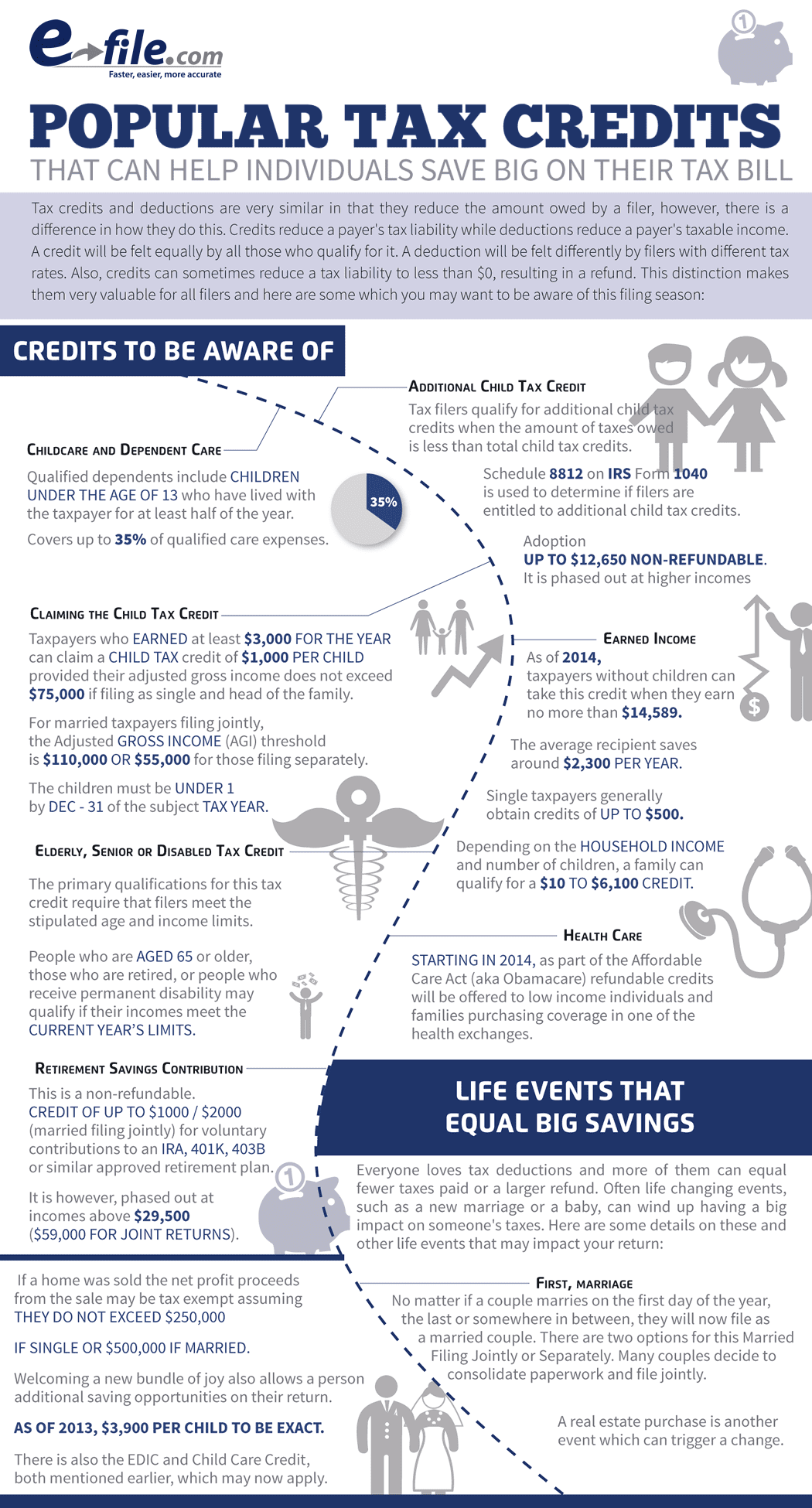
In recent tax seasons, a number of special tax credits have been made available. Some of these credits have expired; others will expire soon. Here are a few of those:
> Recently Expired
The federal clean energy credits have ended. Here’s exactly when each one closed: New and used clean vehicle credits (Sections 30D and 25E) don’t apply to vehicles acquired after September 30, 2025. The Energy Efficient Home Improvement Credit (Section 25C) doesn’t apply to property placed in service after December 31, 2025. The Residential Clean Energy Credit (Section 25D) doesn’t apply to expenditures made after December 31, 2025. The alternative fuel refueling property credit (Section 30C) closes for property placed in service after June 30, 2026. If you bought or installed before those dates, you can still claim the credit on the return for that tax year.
Recently Expired First Time Homebuyer Credit – Tax filers who bought their principal home between April 8, 2008 and May 1, 2010 qualified for the first time homebuyer credit if they had not owned a home in the prior three years. The actual purchase date determined the amount and requirements. The first-time homebuyer credit phased out when the modified adjusted gross income or MAGI reached $150,000 for married couples filing a joint return and $75,000 for other taxpayers who purchased a qualifying home before November 6, 2009. For home purchases after this date, married couples filing jointly got the full credit if their MAGI does not exceed the $225,000 threshold. The same is true for other filers whose MAGI does not exceed $125,000. Taxpayers who claimed the first-time homebuyer tax credit used the qualifying home as their principal residence for at least 36 months or faced repayment of the credit. When first made available in 2009, it offered $8,000 for first-time home buyers. This as well as the federal housing credit for service members (offered $8,000 for first-time home buyers and $6,500 for repeat home buyers) are both expired.
Beginning in 2006 special credits were offered for the purchase of hybrid vehicles; while this has since been phased out, plug-in electric vehicles may still qualify for a credit.
Our software walks you through the credits you’re likely to qualify for as you enter your information, so you don’t have to work out the eligibility rules yourself. Start your return free and see what you can claim.
Quiz: Are These Real Tax Credits or Not?
Tax credits subtract from the amount of tax a person owes. These differ from deductions, which reduce the income that you are taxed on. And while some may be widely known, others are less well known to taxpayers.
-
False. There is no age limit on education-based credits. This includes the credit for lifetime learning, which covers job training courses as well as college education expenses.
-
True. Taxpayers who are on permanent disability and have received taxable disability income for the year can qualify for this credit, as can those who are age 65 or older.
-
True. If you contribute to a retirement account, either on your own or through a workplace, you may qualify for tax savings based on what you contributed to this account.
-
True. The premium tax credit (PTC) is a refundable credit for individuals and families if they buy health insurance through a HealthCare.gov exchange or the Health Insurance Marketplace. This credit is specifically designed to help people pay their health insurance premiums. The value you receive is based on a sliding scale and takes into account your income, household size, and marital status.
-
True. Adopting a child is a wonderful thing for the child and adoptee, but it can be very costly. Taxpayers who recently adopted may be entitled to a credit to help cover adoption expenses include attorney fees, court costs, adoption fees, and travel expenses.