
You qualified for both a tax credit and a tax deduction this year, and you’re trying to work out which one actually puts more money back in your pocket. Guess wrong and you can leave hundreds on the table. Here’s the short answer: a tax credit cuts your tax bill dollar-for-dollar, while a deduction only lowers the income you’re taxed on, so a credit is almost always worth more than a deduction of the same size. Once you know which is which, you can claim every one you qualify for and file with confidence.
What Is a Tax Credit?
Tax credits lessen your tax burden dollar-for-dollar, so the math is simple. The IRS groups the credits available to individual filers into five categories:
- Education
- Homeownership
- Health care
- Savings and income
- Family and dependents
So when you do your taxes, let’s say you take $1,000 of the Lifetime Learning Tax Credit (a tax credit for tuition and enrollment fees should you, your spouse, or a dependent pursue education at a qualifying college or university) and you owe $2,000 in taxes. The tax credit reduces your tax bill by $1,000, so you end up owing the IRS $1,000. If you qualified to take the full $2,000 tax credit, you would owe $0 in taxes.
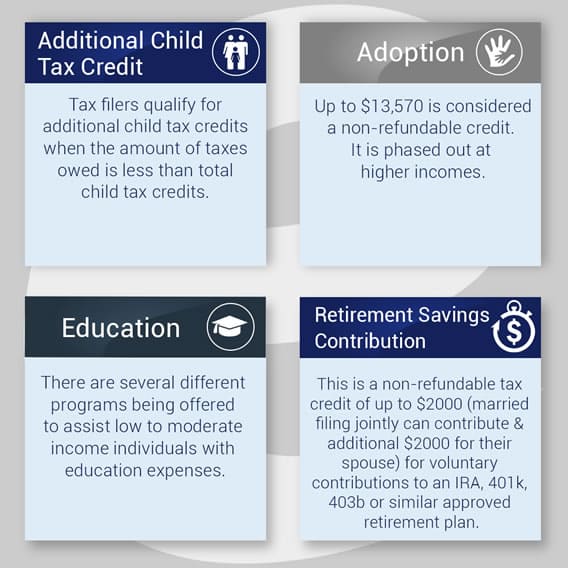
In most cases, tax credits are non-refundable, meaning they can reduce the amount of tax you owe to $0 but can’t result in a refund. There are a few tax credits that do result in a refund, however. Tax filers should also be aware that not all tax credits apply to all tax filers. Some of them have income limits and other qualifying standards, such as age, filing status, employment, and education.
Refundable, Partially Refundable and Nonrefundable Credits
Not every credit works the same way. A refundable credit can pay you even if you owe nothing, a partially refundable credit returns part of what’s left over and a nonrefundable credit can only take your bill down to $0. The Earned Income Tax Credit (EITC) is fully refundable. The Child Tax Credit is partially refundable. The Lifetime Learning Credit is nonrefundable.
Tax Credit vs. Tax Deduction at a Glance
Use this table to see the difference in dollars. Both examples assume a $1,000 tax benefit and a $5,000 tax bill.
| $1,000 tax credit | $1,000 tax deduction | |
|---|---|---|
| What it reduces | The tax you owe | The income you’re taxed on |
| Tax bill before | $5,000 | $5,000 |
| Tax bill after | $4,000 | $4,780 |
| Actual savings | $1,000 | $220 |
What Is a Tax Deduction?
Tax deductions lessen your taxable income based on your marginal tax bracket so you get some benefit. You don’t save as much money with a tax deduction as you do with a tax credit. The IRS offers tax deductions to individuals in several categories, including job-related, business-related, investments, and healthcare deductions. If you qualify for a $1,000 tax deduction and you’re in the 22% bracket, you subtract the full $1,000 from your taxable income — which saves you $220 in actual tax.
Most people take tax deductions, and the standard and itemized deductions are the most common. You might take the standard deduction—an amount set by the IRS—if you don’t want to itemize your deductions, or if your itemized deductions add up to less than the standard deduction. Your standard deduction starts with your filing status, then increases if you’re age 65 or older or blind, and shrinks if another taxpayer can claim you as a dependent. The Tax Cuts and Jobs Act (TCJA) roughly doubled it, which is why most filers now take the standard deduction instead of filing Schedule A (Form 1040). You might itemize your deductions if they exceed the standard deduction.
Below is a short quiz to test your knowledge on the subject of tax deductions and tax credits.
Quiz: Tax Credit or Tax Deduction?
-
True. Tax filers should be aware that not all tax credits are for all tax filers. Some of them have income limits and other qualifying standards, such as age, filing status, employment, and education.
-
False. Tax deductions lessen your taxable income based on your marginal tax bracket so you get some benefit.
-
True. The standard and itemized deductions are the most common. You might itemize your deductions if they add up to more than the standard deduction.
-
False. In most cases, tax credits are non-refundable, meaning they can reduce the amount of tax you owe to $0 but can’t result in a refund.
-
False. The IRS lists 20 tax credits available to individual tax filers in the following categories:
– Education
– Homeownership
– Health care
– Savings and income
– Family and dependents