
Taxes on Selling a House: Your Home Sale Tax Checklist
If you’re selling the home where you’ve lived for several years, it’s important to understand the IRS requirements regarding the proceeds from your sale. If you make a mistake, you could end up paying 15% tax on a gain you wouldn't have had to pay tax on.
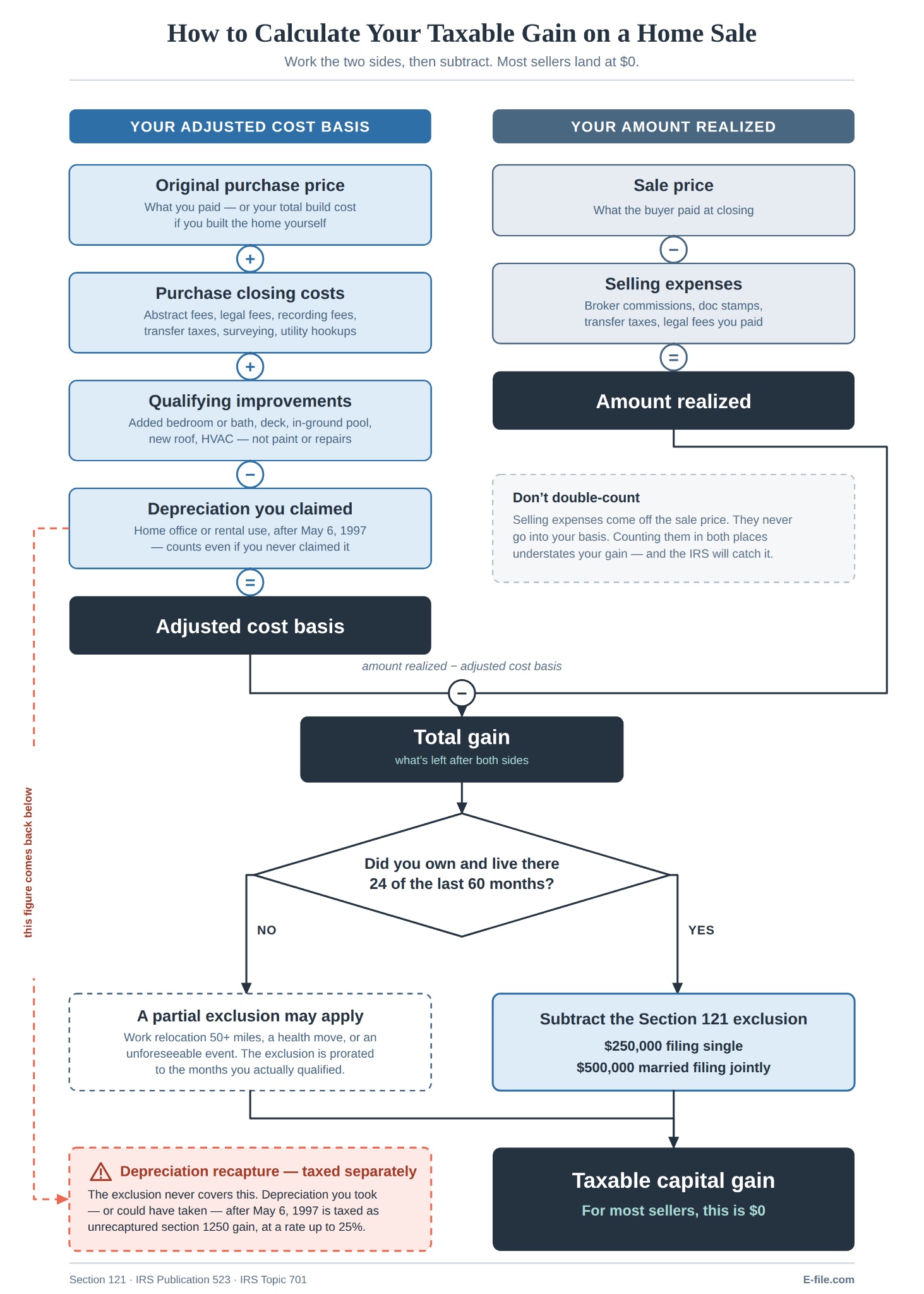
If you have owned and lived in the home for at least two of the past five years, you may qualify to exclude up to $250,000 of profit from taxes—$500,000 if you are filing jointly. As a result, many sellers end up owing nothing in taxes.
To ensure you're fully prepared for closing, please follow the checklist below, gather the necessary receipts, and walk into the closing knowing exactly what you may owe.
Do You Owe Taxes When You Sell Your House?
Basis Treatment
| Item | Effect on Basis | IRS Detail |
|---|---|---|
| Purchase Price | Starting Point | Cost basis is "the amount you pay in cash, debt obligations, other property, or services." Includes the full contract price whether paid in cash or financed. |
| Closing / settlement costs | Increase — but only the qualifying ones | Includable: abstract fees, legal fees (title search, contract, deed), recording fees, surveys, transfer or stamp taxes, owner's title insurance, utility service installation charges. Not includable: points, mortgage insurance premiums, loan assumption fees, credit report and appraisal fees, refinancing charges, casualty insurance premiums, pre-closing rent or utilities. |
| Qualifying improvements | Increase | Must add to the home's value, prolong its useful life, or adapt it to new uses, and have a useful life of more than one year. Includes assessments for local improvements (water connections, sidewalks, roads). Exclude any improvement no longer part of the home at sale (e.g., a replaced water heater). |
| Seller obligations you paid | Increase | Amounts the seller owed that the buyer agreed to pay: back real estate taxes, interest, recording or mortgage fees, charges for improvements or repairs, and the seller's sales commissions. |
| Depreciation after 5/6/1997 | Decrease | Reduce basis by depreciation "allowed or allowable" — you must reduce by the full allowable amount even if you claimed less. Separately, under §121(d)(6) you cannot exclude the portion of gain equal to §1250(b)(3) depreciation adjustments for periods after May 6, 1997; that gain is taxed as unrecaptured §1250 gain (up to 25%). |
| Casualty losses and reimbursements | Both directions - net it | Decrease by any deductible casualty loss taken and by insurance reimbursements received or expected. Increase by amounts spent on repairs that restore the property to its pre-casualty condition. |
| Real estate commissions | Depends on which side | As buyer: commissions you pay as part of acquiring the property are capitalized into cost basis. As seller: commissions are a selling expense — "commissions, advertising fees, legal fees, and loan charges paid by the seller" are subtracted from the selling price to arrive at amount realized, not added to basis. Same dollar effect on gain, different line. |
| Routine repairs | No effect | Costs "necessary to keep your home in good condition but don't add to its value or prolong its life" — painting, fixing leaks, replacing broken hardware, plastering. Not capitalized, not deductible for a personal residence. Exception: repairs done as part of a larger remodel are treated as part of that improvement. |
Does Your Sale Qualify for the Exclusion?
You qualify if you owned the home and used it as your primary residence for at least 24 months out of the five years ending on the sale date. The 24 months do not have to be consecutive, and a vacation home or second residence does not count. Clear that bar and you can exclude up to $250,000 of gain, or $500,000 filing jointly.
One catch worth checking now: if you already excluded gain on another home sale within the two years before this one, you are generally not eligible again.
If You Fall Short of Two Years
Did not make it to 24 months? You may still qualify for a partial exclusion. The IRS allows a prorated exclusion when the sale was driven by a work relocation at least 50 miles farther from your old home, a health-related move, or an unforeseeable event such as divorce, death, job loss or a natural disaster. The exclusion is scaled to the months you actually qualified.
What Counts Toward Your Cost Basis
When calculating the capital gains on the sale of your home, make sure to use the full cost basis of the house. This includes, not just your purchase price, but also any closing costs or other expenses that were a condition of the purchase (such as deed recording and stamps). If you built your home, you can use the cost of building supplies, contractors, permits, surveying and other associated expenses as well.
Which Home Improvements Add to Your Basis?
Maintaining your home should not be used in calculating the basis of your home. However, significant improvements can be included in your basis calculation.
Maintenance includes things like:
- Adding a fresh coat of paint
- Making repairs
Significant improvements includes things like:
- Adding a bedroom/bathroom
- Building an outdoor deck
- Adding an in-ground pool
How a Home Office Changes the Math
Working from home does not affect your eligibility for the capital gains exclusion. If your office is located within your home, such as in a spare bedroom or a converted den, you do not need to divide the gain between business and personal use.
What you do owe is depreciation recapture: depreciation you deducted after May 6, 1997 is taxed as unrecaptured section 1250 gain at a rate of up to 25%, and the IRS applies it even if you never claimed the deduction.
The rule changes if the business space was separate from your living area, such as the rented half of a duplex. There you allocate the gain, and the business portion does not qualify for the exclusion.
Selling Costs That Reduce Your Gain
Any expenses related to your home sale can be used to calculate your net capital gain. Real estate broker commissions, if you bear the cost of the doc stamps, transfer taxes or legal fees are all expenses that can help reduce your stated capital gain and therefore the taxes you will pay.
Do You Have to Report the Sale?
You do not always have to report the sale. If your entire gain is excluded and you didn’t receive a Form 1099-S from the closing agent, you can leave the sale off your return. If you did receive a Form 1099-S, or your gain runs past the exclusion, report the sale on Form 8949 and Schedule D.
A loss on a personal residence is never deductible, no matter what the market did.
First-Time Homebuyer Credit: Where It Stands Now
If you claimed the 2008 first-time homebuyer credit, your 15 annual repayment installments ran from your 2010 return through your 2024 return, so the balance is settled and selling now does not trigger anything. Credits claimed for 2009 and 2010 purchases generally never had to be repaid. There is no federal first-time homebuyer tax credit in place today, so selling will not claw one back.
For more on the tax implications of selling your home, please see the following:
Tax Implications of Selling a Home
Tax Benefits of Home Ownership
The Bottom Line: What Taxes on Selling a House Really Cost You
Most sellers are caught off guard only because they did not keep receipts. Confirm the two-of-five-year test, add every qualifying improvement to your basis, subtract your selling costs, and check whether you ever depreciated a home office. Then file it right — E-file.com walks you through the home sale questions and files your federal return, with a free tier for simple situations.
Frequently Asked Questions
Do I have to report the sale of my home on my tax return?
Not always. If your entire gain qualifies for the home sale exclusion and you did not receive Form 1099-S, you typically do not need to report the sale. However, if you received Form 1099-S or if your gain exceeds the exclusion amount, you will generally report the sale using Form 8949 and Schedule D.
Can home improvements reduce the taxes I owe when I sell my house?
Yes. Certain improvements can increase your home's cost basis, which can reduce the amount of gain that's subject to tax when you sell. Qualifying improvements generally include projects that add value, extend the home's useful life or adapt it to a new use, such as adding a bathroom, building a deck or installing an in-ground pool. Routine maintenance and repairs generally don't count.
How much capital gains tax will I pay when I sell my house?
You may not owe any capital gains tax. If you owned and used the home as your primary residence for at least two of the five years before the sale, you may be able to exclude up to $250,000 of gain if you're single or $500,000 if you're married filing jointly. If your gain exceeds your available exclusion, the remaining amount may be taxable.