
Business Tax Extension: How to File Form 7004 in 2026
If your business or nonprofit needs extra time to file its taxes, you can file for an extension. This is also true for individuals (more on individual extensions), but the deadlines, rules, and forms are different.
What Is a Business Tax Extension?
A business tax extension is a formal request that gives your business additional time to file its federal income tax return without triggering a failure-to-file penalty. The key thing to understand before you file one: an extension moves your filing deadline, not your payment deadline.
You are still expected to pay any estimated taxes owed by your original due date, even if you cannot complete your return on time. When you do file your return, the IRS will either bill you for any remaining balance or issue a refund if you overpaid.
Filing an extension and paying your estimated tax on time is the best way to avoid both the failure-to-file and failure-to-pay penalties.
The extension itself is automatic, so you do not need to explain why your business needs more time. As long as Form 7004 is completed accurately and filed by your return's original due date, the IRS grants the extension without review. The IRS will only contact you if there is a problem with the form.
Business Tax Extension Deadlines by Entity Type
The deadline to file Form 7004 depends on your entity type. Most calendar-year businesses have either a March or April original due date; a timely extension moves that deadline six months forward.
| Entity Type | Return Filed | Original 2026 Deadline | Extended 2026 Deadline |
|---|---|---|---|
| S-Corporation | Form 1120-S | March 16, 2026 | September 15, 2026 |
| Partnership | Form 1065 | March 16, 2026 | September 15, 2026 |
| C-Corporation | Form 1120 | April 15, 2026 | October 15, 2026 |
| Trust / Estate | Form 1041 | April 15, 2026 | September 30, 2026 |
| Tax-Exempt Organization | Form 990 (via Form 8868) | May 15, 2026 | November 16, 2026 |
How to File Form 7004: Step-by-Step
Most businesses can file Form 7004 electronically through the IRS Modernized e-File (MeF) system. E-filing is faster, generates an immediate acknowledgment, and reduces the risk of processing errors. Here is how to complete it:
Step 1: Gather your business information
You will need your Employer Identification Number (EIN), legal business name, address, and the tax year you are extending. These must match exactly what appears on your business tax return.
Step 2: Identify the return you are extending
Form 7004 covers more than 30 return types. Select the correct form code for your entity. For example, Form 1120-S for S-corporations, Form 1065 for partnerships, and Form 1120 for C-corporations.
Step 3: Estimate your tax liability
Even if your books are not finalized, you must estimate what your business owes. You are not required to be exact, but the estimate should be reasonable. If your entity is a pass-through and owes no entity-level tax, enter zero.
Step 4: Pay any estimated tax due
If your estimate shows a balance owed, submit payment by the original return due date, not the extended due date. You can pay via IRS Direct Pay, EFTPS, or by check with a payment voucher.
Step 5: File Form 7004 by your original due date
Submit Form 7004 electronically through the MeF system or by mail to the IRS service center for your entity type.
Once accepted, your extension is granted. The IRS will only follow up if the form is incomplete or your estimated payment is significantly understated.
Ready to file? E-file.com makes it straightforward to stay compliant and file on time. Start your business extension filing.
Business Tax Extension for Nonprofits (Form 8868)
Tax-exempt organizations use Form 8868 to request additional time to file Form 990, 990-EZ, or 990-PF. Form 8868 provides a single automatic 6-month extension. File it by your original due date, typically May 15 for calendar-year organizations, and the extension is granted without explanation.
Business Tax Extension vs. Personal Tax Extension
Whether your business files on a business return or your personal return determines which extension form you need. Here is how to tell the difference.
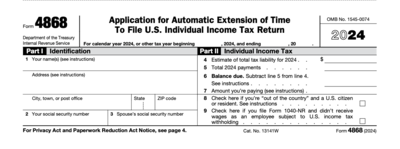
- Sole proprietors (Schedule C filers): If you are a sole proprietor, your business income is reported directly on your personal Form 1040 via Schedule C. No separate business return is required. If you need more time to file, use Form 4868, the individual extension, by April 15. You do not file Form 7004.
- Partnerships: Partnerships report income on Form 1065 and distribute Schedule K-1 to each partner. Although partnerships are business entities, those that pass income through to partners on individual returns use Form 7004 for the partnership's return. Individual partners who need more time for their personal return file Form 4868 separately.
- LLCs and corporations: If your LLC is treated as a corporation for federal tax purposes and files Form 1120, it uses Form 7004 to extend its deadline. Most corporate returns are due on the 15th day of the third month following the close of the tax year. For calendar-year filers, that is March 15, or March 16 in 2026, since March 15 falls on a Sunday.
If you are unsure which extension applies to your business, a tax professional can confirm.
Frequently Asked Questions
What happens if you miss the business tax extension deadline?
If you miss your extension deadline or never filed Form 7004 in the first place, the IRS treats your return as late from the original due date. The failure-to-file penalty is 5% of unpaid tax per month, up to 25% of the total balance owed, and the failure-to-pay penalty is 0.5% of unpaid tax per month, also up to 25%.
Does a business tax extension give you more time to pay?
No. Form 7004 only extends your filing deadline; it does not extend your payment deadline. Any tax your business owes is still due on the original return due date.
Which businesses use Form 7004 vs. Form 8868
Form 7004 is for businesses: S-corporations, C-corporations, partnerships, LLCs taxed as corporations, and trusts. Form 8868 is exclusively for tax-exempt organizations filing Form 990 and related returns.
Can you file a business tax extension online?
Yes. The IRS accepts Form 7004 electronically through its Modernized e-File (MeF) system, and e-filing is the recommended method. You receive immediate confirmation that the IRS received your request, eliminating the uncertainty of paper filing and postmark timing.